 EN
EN

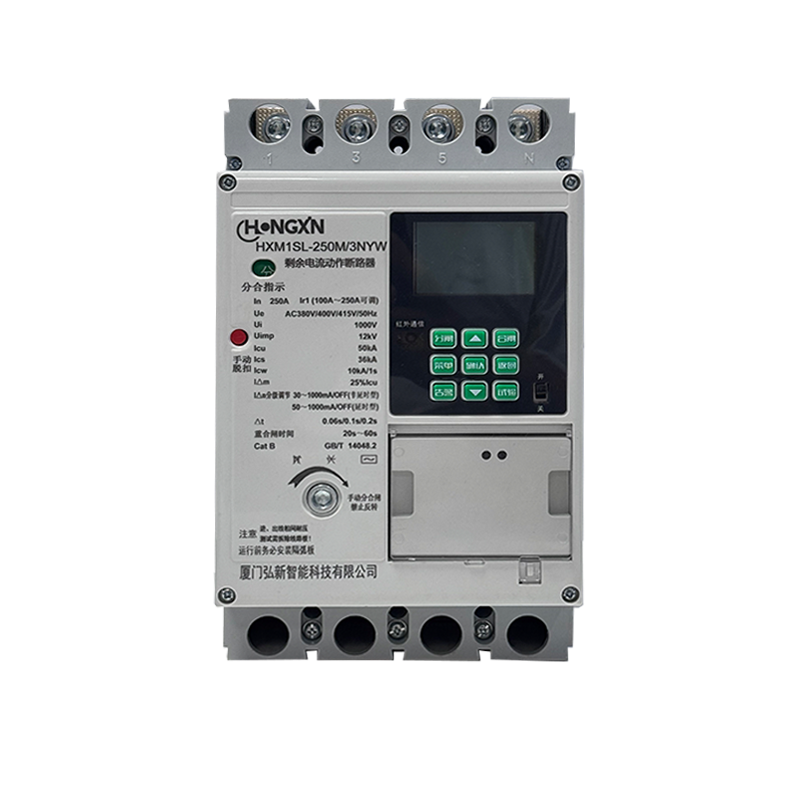
Core MCCB Protection Functions — The Baseline
A molded case circuit breaker — the mccb designated by IEC 60947-2 — protects circuits against two faults. Overload protection responds to sustained overcurrent using a bimetallic strip that heats and trips on an inverse-time characteristic. Short-circuit protection responds to fault currents 5 to 10 times rated within milliseconds via an electromagnetic solenoid. This thermal-magnetic mechanism is the baseline. It does not protect against earth leakage, undervoltage, phase loss, or remote commands — those require add-on modules.
Overload, Short Circuit, and the Thermal-Magnetic Trip Mechanism
The standard mccb thermal-magnetic trip unit uses two principles. The thermal element — a bimetallic strip heated by load current — deflects proportionally to I²t, replicating cable heating. At 1.45× rated, the breaker must trip within one hour per IEC 60947-2. The magnetic element trips instantly (under 20 ms) when current exceeds the pickup threshold. What this does not do: detect 30 mA leakage, trip on voltage sag below 70%, or respond to a remote BMS signal.
Real-World Case — A Manufacturing Plant Adds Earth-Leakage Protection to Its MCCB Fleet
A mid-sized electronics plant in Eastern Europe experienced three nuisance trips of its main incomer mccb over six months. Investigation traced the issue to cumulative earth leakage — individual machine leakage of 8 to 15 mA across 40 machines summed to 400+ mA, spiking above the incomer's 500 mA threshold during humid weather. The solution, designed with HONGXINAIOT (Xiamen Hongxin Intelligent Technology), a high-tech enterprise with 24 years of parent-company power distribution experience, retrofitted branch-circuit mccb units with earth-leakage modules set to 100 mA per branch. Nuisance trips stopped. Branch-level monitoring enabled maintenance teams to identify elevated leakage before tripping — converting outages to scheduled maintenance.
Add-On Protection Modules That Expand MCCB Capability
Shunt Trip, Undervoltage Release, Earth-Leakage Module, and Motor Protection
A modern mccb accepts four categories of add-on protection modules without replacing the breaker. A shunt trip release — energized by an external voltage signal from a fire alarm panel, emergency stop button, or BMS relay — trips the breaker remotely within 50 ms of receiving the signal. An undervoltage release (UVR) trips the breaker when supply voltage drops below 70% to 35% of nominal and prevents reclosure until voltage recovers to above 85%, protecting motors from stalling and restarting under load. An earth-leakage module with an external core-balance current transformer (CBCT) detects residual current as low as 30 mA for personnel protection or 100 mA to 30 A for equipment protection, adding RCD functionality to a standard breaker. A motor protection module adds phase-loss and phase-unbalance detection — critical for three-phase motor circuits where single-phasing destroys windings within minutes.
Electronic Trip Units — Programmability and Communication
Adjustable Trip Curves, Data Logging, and Modbus/Fieldbus Integration
An electronic trip unit replaces the fixed thermal-magnetic mechanism inside an mccb with a microprocessor-based protection relay. The advantages are threefold. Adjustable trip curves — long-time pickup from 0.4 to 1.0× rated current, short-time pickup from 1.5 to 10×, instantaneous pickup from 2 to 15× — enable protection coordination across multiple breaker tiers without physical hardware changes. Data logging — the trip unit records the magnitude and timestamp of the last 5 to 10 fault events, including phase-specific currents and the type of fault (overload, short-circuit, earth fault) — provides forensic data for root-cause analysis after a trip. Communication — Modbus RTU, Modbus TCP, or Profibus interfaces — integrates the breaker into the plant's SCADA or energy management system for real-time current monitoring, energy metering, and remote trip/close commands. An mccb with an electronic trip unit and communication module becomes a power-quality sensor, not just a protection device.
Application-Specific MCCB Configuration Guidance
Commercial Buildings, Industrial Motor Control, and Renewable Energy Systems
Commercial building distribution — an mccb protecting a sub-distribution board feeding lighting and socket circuits benefits from an earth-leakage module set to 300 mA for fire protection per IEC 60364. Industrial motor control — a breaker feeding a 30 kW pump motor requires a motor protection module with phase-loss detection and an undervoltage release to prevent automatic restart after a brownout. Renewable energy systems — solar inverter AC combiner boxes need breakers rated for bidirectional current flow and elevated ambient temperature (50°C to 60°C inside an inverter enclosure) with appropriate derating. HONGXINAIOT provides customized power distribution solutions — including mccb assemblies with application-specific add-on module configurations — for global markets with region-specific standards compliance.
Frequently Asked Questions
Can an MCCB detect earth leakage?
A standard mccb does not detect earth leakage. Adding an earth-leakage module with an external core-balance current transformer enables residual current detection from 30 mA to 30 A, depending on the selected module. HONGXINAIOT supplies compatible add-on modules.
What is the difference between shunt trip and undervoltage release?
A shunt trip on an mccb trips the breaker when it receives an external voltage signal — used for fire alarm integration and emergency stop. An undervoltage release trips when supply voltage drops and prevents reclosure until voltage recovers — used for motor protection.
Can an MCCB communicate with a building management system?
Yes. An mccb with an electronic trip unit and Modbus RTU/TCP or Profibus communication module transmits real-time current, voltage, power, and fault data to a BMS or SCADA system for remote monitoring and energy management.
What add-on protection is needed for a motor circuit MCCB?
A motor circuit mccb should be equipped with phase-loss and phase-unbalance detection, an undervoltage release to prevent brownout restart, and optionally an earth-leakage module. The standard thermal-magnetic trip unit alone is insufficient for motor protection.
How do you coordinate protection between multiple MCCBs?
Protection coordination between mccb units uses time-current curve analysis — the downstream breaker must trip before the upstream breaker for any fault current within its zone. Electronic trip units with adjustable curves simplify coordination without hardware changes.
Can an MCCB be used in a solar PV system?
Yes. An mccb in a solar PV AC combiner box must be rated for bidirectional current, derated for 50°C to 60°C ambient temperature inside the enclosure, and selected with appropriate DC voltage rating if used on the DC side. HONGXINAIOT provides application-specific breaker configurations.