 EN
EN

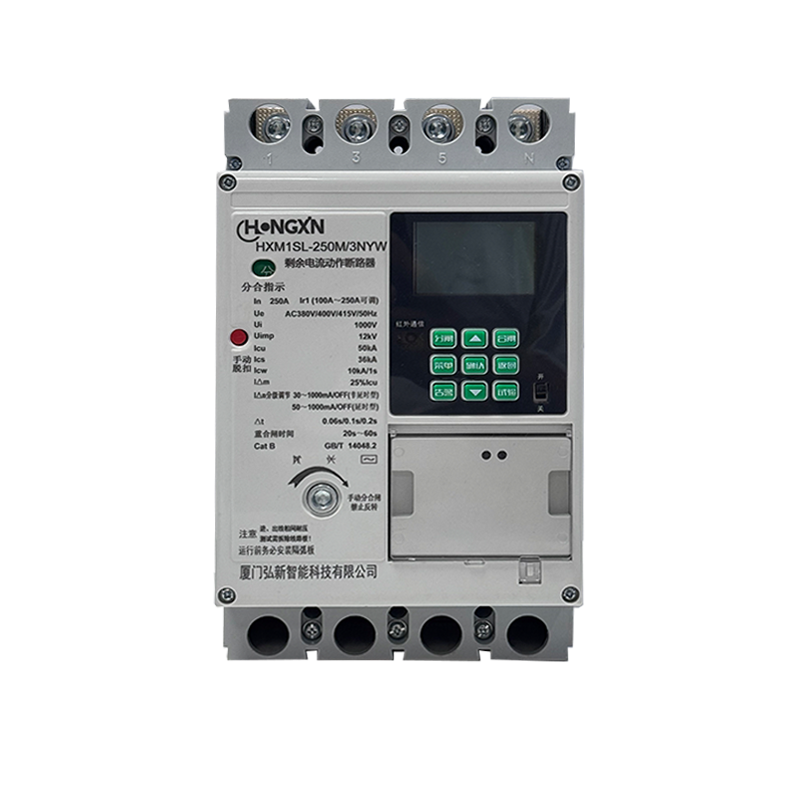
Two Protection Mechanisms in One Compact Frame: Inside Industrial Circuit Protection
Every industrial power distribution system faces two distinct electrical threats: sustained overloads that gradually overheat conductors and sudden short circuits that deliver catastrophic current magnitudes within milliseconds. A molded case circuit breaker — the MCCB found in switchboards, panelboards, and motor control centers worldwide — handles both within a single compact device. Understanding how the internal trip mechanisms distinguish between these fault types explains why this device has become the backbone of low-voltage circuit protection from 16 A to 1600 A.
The core protection within a MCCB operates through two parallel detection paths sharing a common tripping mechanism. The thermal element responds to overloads using a bimetallic strip that bends when heated by current flow. The magnetic element responds to short circuits using an electromagnetic coil that generates instantaneous tripping force when current exceeds a calibrated threshold. The two systems operate independently yet converge on the same latch mechanism.
Thermal Protection: The Overload Detection System
How Bimetallic Strips Translate Current Into Mechanical Motion
A bimetallic strip consists of two metals with different coefficients of thermal expansion bonded together — typically steel and copper. When load current passes through or near this strip, resistive heating raises its temperature, and the differential expansion bends the strip in a predictable curve that acts directly on the trip latch.
The relationship between current and trip time follows an inverse-time characteristic standardized in IEC 60947-2. At 113% of rated current, the breaker must not trip within one hour. At 145%, it must trip within one hour. This inverse-time behavior mirrors the thermal damage curve of copper conductors — the very equipment the MCCB protects.
Ambient temperature matters. A MCCB installed in a hot enclosure at 55°C will trip at a lower actual current than its nameplate rating suggests because the bimetallic strip starts from a higher baseline temperature. For high-ambient environments, electronic trip units with microprocessor-based thermal modeling eliminate this variability.
Magnetic Protection: The Instantaneous Short-Circuit Response
The magnetic trip element consists of a coil wound around a movable armature. Under normal load current, the magnetic flux is insufficient to overcome the armature spring. When a short circuit drives current to 5 to 10 times the breaker's rated value, the flux pulls the armature against the spring with enough force to strike the trip latch directly — a process completed within 5 to 10 milliseconds.
This speed matters because short-circuit current rises extremely quickly in low-impedance circuits. The magnetic trip disconnects the circuit while the fault current is still rising toward its prospective peak, limiting the let-through energy (I²t) that downstream equipment must withstand. Per IEC 60947-2, energy-limiting Class 2 and Class 3 breakers provide progressively higher degrees of current limitation.
Electronic trip units represent the evolution beyond thermal-magnetic. A microprocessor continuously samples current via internal current transformers, calculating true RMS values. It can implement long-time delay for overloads, short-time delay for selective coordination, instantaneous for close-in faults, and ground-fault protection — all in one device. The trip curve is adjustable via DIP switches or digital interface, allowing a single breaker frame to serve diverse applications. Hongxin Intelligent Technology MCCB product lines include both thermal-magnetic and electronic trip configurations.
A Commercial Building Retrofit in the Middle East
A 12-story mixed-use building in Dubai experienced nuisance tripping on its main 1600 A MCCB during summer afternoons when all HVAC chillers ran simultaneously. The load measured approximately 1420 A — within the breaker's rating — but the thermal trip was activating because the electrical room ambient temperature reached 48°C without adequate ventilation.
Rather than upsizing the breaker and all downstream cabling — a six-figure retrofit — the facility engineering team worked with Hongxin Intelligent Technology to replace the fixed thermal-magnetic trip unit with an electronic trip unit featuring ambient temperature compensation. The electronic unit sampled case temperature via an internal sensor and adjusted the long-time pickup threshold accordingly. After the retrofit, the breaker consistently carried the 1420 A load without tripping, while still providing full overload protection at the correct current threshold.
Selection and Coordination Best Practices
Frame size, interrupting rating, and trip unit selection together define the right MCCB for any circuit. Frame size determines physical dimensions and maximum ampere rating — a 250 A frame with a 200 A trip unit is a common configuration. The interrupting rating must exceed the available fault current at the installation point; undersizing here means the breaker may fail to clear a fault safely.
Selective coordination ensures that only the nearest upstream device to the fault opens, minimizing outage scope. This requires time-current curve analysis: the downstream breaker's total clearing time must fall below the upstream breaker's short-time delay pickup. Modern electronic trip units simplify this with adjustable short-time delay settings from 0.05 to 0.5 seconds with optional I²t shaping.
Frequently Asked Questions
What does MCCB stand for and where is it used?
MCCB stands for Molded Case Circuit Breaker. These devices protect low-voltage circuits up to 1600 A in industrial switchboards, commercial panelboards, and motor control centers. The molded case — typically glass-filled polyester or thermoset composite — provides insulation and structural integrity while containing arc gases during interruption.
How is an MCCB different from an MCB?
An MCB (Miniature Circuit Breaker) handles up to 125 A with fixed, non-adjustable thermal-magnetic trip elements. An MCCB covers 16 A to 1600 A, offers adjustable trip settings on many models, higher interrupting ratings (up to 150 kA versus 10-25 kA for MCBs), and supports accessories like shunt trips and auxiliary contacts. Hongxin Intelligent Technology supplies both product ranges.
Can I use an MCCB for motor protection?
Thermal-magnetic MCCBs can protect motor circuits, but motor starting inrush — typically 6 to 8 times full-load current — may cause magnetic trip nuisance tripping unless the instantaneous pickup is set appropriately. Dedicated motor circuit protectors (MCPs) or MCCBs with adjustable magnetic trip settings work better than fixed-trip breakers for motor applications.
How often should MCCBs be tested?
NFPA 70B recommends exercising molded case breakers annually — manually switching them off and on to verify free mechanism operation. Insulation resistance testing between phases and to ground should be performed every 3 to 5 years. Breakers that have interrupted a major fault should be inspected before re-energization.
What are the common causes of MCCB nuisance tripping?
Loose cable terminations generate heat that conducts to the thermal element, causing false overload trips. Harmonic currents from non-linear loads can cause electronic trip unit misreading if the unit measures average rather than true RMS current. Undersized breakers for high-inrush loads (transformers, motors, capacitor banks) trip on the magnetic element during normal energization.
What accessories are available for MCCBs?
Common accessories include shunt trip coils for remote tripping, undervoltage releases, auxiliary contacts for status indication, alarm contacts that signal only on trip, motor operators for remote closing, and rotary handles for through-door operation. These accessories install in the breaker frame without affecting trip unit calibration.